
Hum Sun Rahe Hai
Suno, Samjho, Sath do
This initiative responds to a critical gap between noticing signs of distress and taking timely action. Often, moments that call for attention are overlooked, delayed, or misunderstood, leading to consequences that cannot be reversed.
By encouraging early response and thoughtful engagement, the effort seeks to make care more immediate and accessible. At its core, it is about ensuring that no signal goes unseen, and no moment for support is missed.
Not Just a Story. A Reality.
Last year, in a Tier-2 city, a college student had been dropping signals for weeks. He stopped attending classes. His attendance dropped, but no one followed up. His friends noticed, but assumed “phase hai (It is just a phase).” At home, he became quieter, but it was dismissed as “mobile addiction.”
One evening, he posted a vague Instagram story: “Thanks for everything.” Dozens saw it. No one responded in time. That night, we lost him. Afterwards, everyone said the same thing: “I wish I had reached out.”
This campaign exists for that gap. Between noticing… and acting.
The Cost of Waiting
If someone has a heart attack in front of you, you don’t step back and say, “Let me wait for the doctor to come.” You don’t wait for the perfect expert to arrive. You act. Even if your hands shake. Even if you’re not fully trained. Because you know, those first few minutes matter.
Now something very similar happens every day, just quieter and less visible, not loudly, not dramatically, but in small, almost invisible ways. But we don’t act. We think: “Maybe I’m overthinking.” “Maybe they need space.” “What if I say the wrong thing?” “I don’t want to interfere.” and that hesitation costs lives. Because the window is small. Sometimes, it is just one conversation wide.
What If We Responded Differently?
Imagine a country that doesn’t wait for tragedy to start caring. A country where, in every classroom, whether it’s a government school in a small village or a private college in a big city, there are at least two people who know how to respond when someone says, “I’m not okay.” Not experts but just students, teachers, or peers who have learned the basics of emotional first aid.
Imagine friend groups where care is not awkward. Where someone notices when the most talkative person suddenly goes quiet, or when the one who always jokes starts withdrawing. Where “I’m tired” is not brushed off as just another line, but held with a little more attention, a little more curiosity. Where checking in is normal, not dramatic.
This wouldn’t be a perfect country. People would still struggle. Pain would still exist. There would still be days when we don’t know what to say, moments when we get it wrong and times when we feel unsure. But even in that imperfection, there would be something powerful, a shared willingness to not look away. A quiet understanding that when someone is on the edge, even a small act of presence can pull them back.
And that is enough. Not enough to fix everything. Not enough to eliminate suffering. But enough to interrupt the silence. Enough to create a pause between thought and action. Enough to remind someone, in their darkest moment, that they are not completely alone.
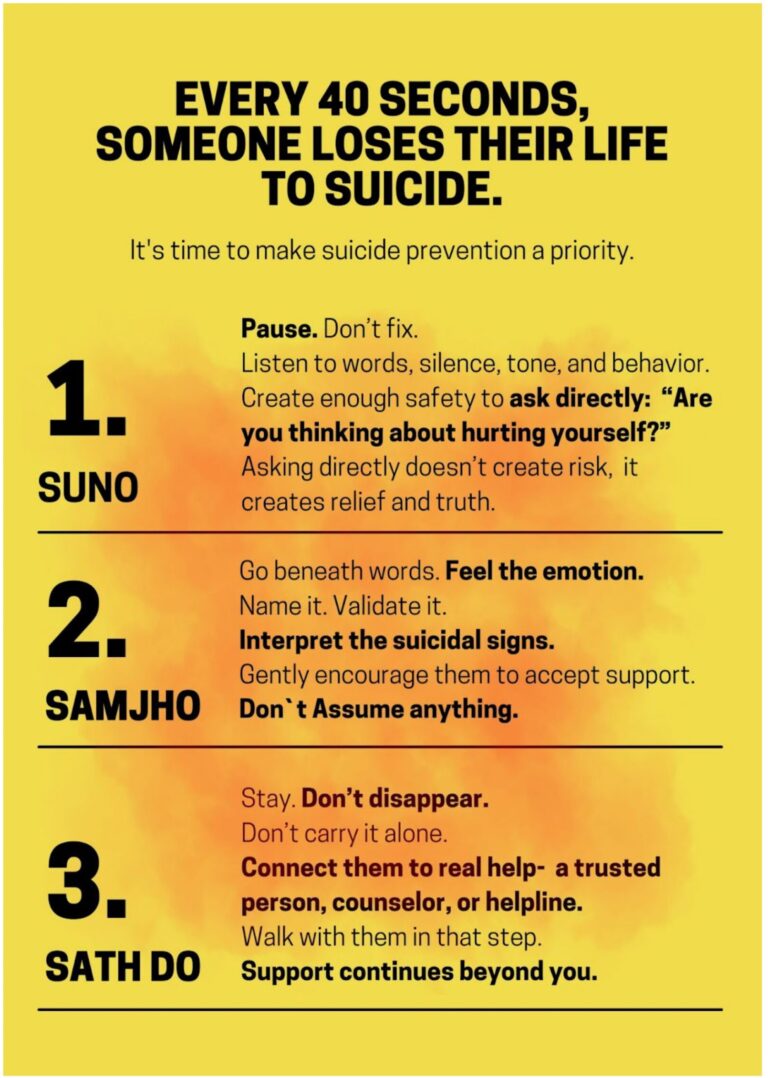
A Simple Way to Respond - Suno , Samjho , Sath Do
Suno –
It encourages timely, honest conversations that can surface hidden distress.
In doing so, it helps people feel seen, heard, and supported when it matters most..
Samjho –
Look beyond words to the emotion beneath.
Acknowledge and validate what is felt,
notice signs of distress, and
gently guide toward support—without assumptions.
Sath Do –
Stay present and do not withdraw.
Share the responsibility by connecting them to trusted support—whether a person, counselor, or helpline.
Remain alongside them through that step,
recognizing that care continues beyond a single interaction.
Creating Awareness and Actions
For the next fews months, across cities, colleges, WhatsApp groups, and small circles, we are quietly building something powerful.
3) We are hosting listening circles (online and offline both)
Online and offline circles where participants learn to hold space, practise active listening, understand emotional literacy, and build compassion-based communication skills. Where people practisea nd start to observe others in need around them.
4) We are bringing experts.
In the second part of the campaign (after july 2026) we will bring Psychologists, counsellors, and facilitators to share insights on depression, anxiety, emotional support, crisis response, and community care..
5) We are building a resource backbone
A growing library of helplines, guides, articles, toolkits, and verified support networks across India.
1) We are creating simple, shareable videos
Short, accessible videos about mental health, warning signs, myths, and simple do’s and dont’s, created for schools, colleges, youth groups, and families. Like on real situations: “What do you say when someone says ‘I’m tired of everything’?”
2) We are designing tools
Dozens of simple, self-guided tools: Cards. Prompts.Listening Exercises.Booklets. Check-in formats.Songs. So that even someone with zero training can start a meaningful conversation.
6) We are hosting a large gathering in June
One large, intensive gathering bringing together youth, educators, community leaders, and partners for a full-day learning and action session.